AP Physics B Didn't Fail Students. We Failed AP Physics B

Why the AP Physics 1 redesign narrowed the curriculum without solving the real problem: how physics is taught
Summary:
The College Board replaced AP Physics B with AP Physics 1 and 2 in an effort to reduce breadth and promote deeper conceptual understanding, but the real problem was never that Physics B covered too much content in 2014,. The deeper failure was instructional design: students were often taught physics as disconnected formula-matching rather than as a coherent structure of recurring ideas such as force, energy, momentum, fields, oscillation, and conservation. While AP Physics 1 changed the exam to emphasize reasoning, explanation, and conceptual understanding, many classrooms did not receive the curriculum, training, or teaching tools needed to match that shift. A better reform would have preserved a comprehensive algebra-based physics pathway while redesigning instruction through spaced retrieval, interleaving, worked-example fading, explicit schema construction, and integrated conceptual-quantitative assessment. AP Physics B did not fail because it was too broad; it failed because its breadth was not taught as structure.

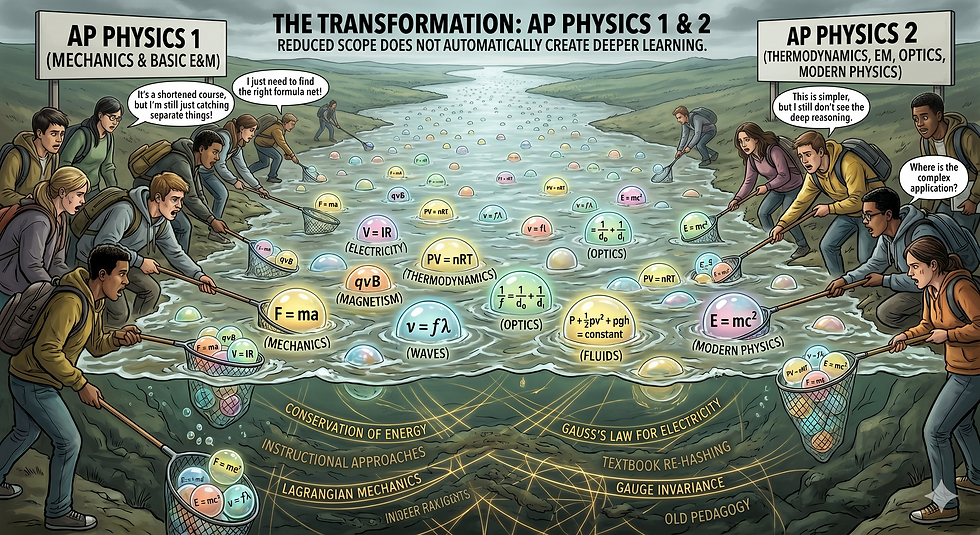
In 2014, the College Board retired AP Physics B, the single-year algebra-based course that covered mechanics, electricity and magnetism, thermodynamics, optics, waves, fluids, and modern physics. In its place came AP Physics 1 and AP Physics 2, two separate courses designed to reduce breadth and promote deeper conceptual understanding.
The diagnosis was partly right. Too many students were learning physics as formula matching. They could plug numbers into equations without understanding the physical ideas underneath them.
But the prescription was wrong.
AP Physics B did not fail because physics was too broad. It failed because the system around it did not teach that breadth coherently. The real problem was not the table of contents. The real problem was instructional design.
The College Board treated a pedagogy problem as a content problem. Instead of redesigning how students learn physics, they narrowed what students were expected to learn. That decision reduced the scope of the course, but it did not guarantee deeper understanding. It changed the exam, but it did not sufficiently change the classroom.
More than a decade later, the lesson is clear: less content does not automatically create deeper learning. Breadth is not the enemy. Fragmentation is.
The Case College Board Made
The redesign of AP Physics B was built on three reasonable-sounding ideas.
The first was depth over breadth. Physics B, critics argued, tried to cover too much in one year. Students moved quickly through mechanics, electricity and magnetism, waves, optics, thermodynamics, fluids, and modern physics. The course was often described as “a mile wide and an inch deep.” The solution seemed obvious: reduce the number of topics so teachers could slow down and build conceptual understanding.
The second idea came from physics education research. Researchers such as Eric Mazur, David Hestenes, and Lillian McDermott had shown that students in traditional physics courses could often solve quantitative problems while still holding basic misconceptions about force, motion, energy, and fields. Students could calculate the right answer without actually understanding the physics.
The third idea was access. AP Physics B had a reputation for being difficult and intimidating. A narrower first-year physics course, the argument went, would be more approachable. More schools would offer it. More students would take it. More students would succeed.
Each of these ideas had merit. The problem was how College Board translated them into policy.
The old course did have a depth problem. But the depth problem did not come simply from the number of topics. It came from how those topics were usually taught.
The Time Budget Was Not the Main Problem
One of the strongest arguments against AP Physics B was that there was not enough time to teach so much material well.
That sounds convincing until we look more carefully at how time is used.
A typical college algebra-based physics sequence runs across two semesters. Students may have several hours of lecture, recitation, and lab each week. A high school AP Physics course, however, often meets five days a week for most of the school year. In raw contact hours, a full-year AP course can have enough time to cover a substantial amount of physics.
Of course, contact hours alone do not prove that high school students can duplicate a college sequence. College students are older, often more mathematically prepared, and expected to do more independent work. High school classes also face interruptions, uneven preparation, and wider differences in student readiness.
But the time comparison still matters because it weakens the simple claim that Physics B was doomed by breadth alone.
The more important question is not “How many topics are on the syllabus?” The more important question is “What happens during the instructional time?”
If class time is spent presenting formulas, demonstrating one example, assigning twenty similar problems, and then testing the same pattern, even a narrow course will remain shallow. If class time is used for conceptual modeling, structured practice, retrieval, interleaving, laboratory reasoning, and explicit comparison across domains, then a broad course can become coherent.
Physics B did not need less physics first. It needed better design.
What Actually Changed in the Classroom
I have taught AP Physics for over twelve years, including the period before and after the transition from AP Physics B to AP Physics 1 and 2. What I saw in the classroom was simple and revealing.
The exam changed more than the teaching materials did.
Teachers were told that AP Physics 1 would promote deeper conceptual understanding. But in many classrooms, the actual materials looked like a shortened version of the old course. Fewer chapters. Fewer topics. Similar textbooks. Similar problem sets. Similar instructional routines.
The daily classroom experience did not transform enough to match the new exam.
That mismatch became the central failure of the reform. AP Physics 1 asked students to explain, justify, reason qualitatively, design experiments, and argue from evidence. Those are valuable skills. But they require a different kind of teaching. They require explicit modeling of reasoning. They require students to compare cases, explain causes, revise misconceptions, and connect equations to physical meaning.
Most teachers were not given enough support to make that transition. Many textbooks did not model it well. Many schools adopted the new course without rebuilding the instructional system around it.
The exam changed. The classroom did not.
Pass Rates and the Access Illusion
The equity argument behind AP Physics 1 was that a narrower course would lower the barrier to entry and expand access.
More students did take AP Physics 1. But for much of its first decade, AP Physics 1 had unusually low success rates compared with many other AP exams. In several years, the percentage of students earning a 3 or higher remained in the low-to-mid 40s. Recent score distributions have improved, especially after exam and course adjustments, but the larger issue remains.
The redesign did not simply make physics easier. It changed the type of difficulty.
AP Physics B rewarded broad computational fluency. A prepared student could succeed by mastering many problem types across many topics. AP Physics 1 narrowed the content, but increased the demand for verbal explanation, qualitative reasoning, experimental design, and conceptual justification.
That is not necessarily a bad thing. Physics should require conceptual reasoning. But if students are assessed on a deeper form of thinking, they must be taught that deeper form of thinking.
Otherwise, narrowing content does not create access. It creates a new gate.
The students who struggle are often not struggling because they are incapable of physics. They are struggling because the course demands one kind of reasoning while the classroom often trains another.
The College Credit Problem
There is also a practical issue for college-bound students.
AP Physics B once offered many strong students a comprehensive algebra-based physics experience in a single year. A student who performed well could sometimes receive credit or placement for a full introductory algebra-based physics sequence, depending on the university.
AP Physics 1 alone does not replace that experience. It covers only part of the old Physics B scope. Students who want the closest equivalent to AP Physics B now need both AP Physics 1 and AP Physics 2. But many high schools offer only AP Physics 1.
That means the comprehensive algebra-based AP physics pathway has become harder to access.
For students headed into engineering or physical science, AP Physics C may be the stronger option. But AP Physics C requires calculus or concurrent calculus, and it is not offered in every school. For students in schools without AP Physics C, the old Physics B pathway served an important role.
The irony is that a reform partly justified by access may have made the most valuable outcome, meaningful college-level preparation, harder for some students to reach.
The Real Diagnosis: Formula-First Teaching
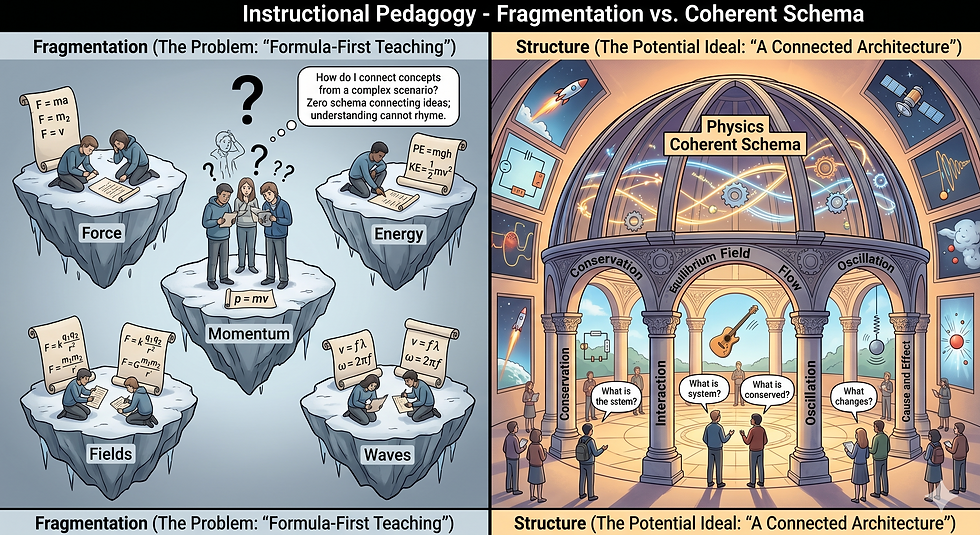
The real problem with AP Physics B was not that mechanics and electricity appeared in the same course. The problem was that students often experienced physics as a collection of disconnected formulas.
This is what I call formula-first teaching.
The teacher introduces an equation. Then the teacher solves a sample problem. Then students solve similar problems. Then the test changes the numbers.
This method can produce short-term performance. But it rarely produces deep understanding.
Students learn that physics is about choosing the right equation from a list. They ask, “Which formula do I use?” before asking, “What is happening physically?” They treat force, energy, momentum, charge, fields, and waves as separate boxes rather than connected structures.
The result is fragile knowledge. Students can solve a familiar problem but freeze when the surface features change. They can calculate acceleration but cannot explain why the motion changes. They can use conservation of energy but cannot identify the system. They can memorize Coulomb’s law but fail to see its connection to Newton’s law of gravitation.
That is not a content-volume problem. That is a schema problem.
Students need mental structures that organize physics. They need to see that the same ideas return again and again in different forms.
Breadth Can Be a Strength
The deepest learning in physics happens when students stop seeing units as separate chapters and start seeing them as transformations of the same underlying structures.
Mechanics, electricity and magnetism, waves, thermodynamics, fluids, and modern physics are not isolated territories. They are recurring patterns.
Conservation. Interaction. Equilibrium. Field. Flow. Oscillation. Symmetry. Energy transfer. System boundaries. Cause and effect.
A broad course can overwhelm students if it is taught as a list. But if it is taught as a connected architecture, breadth becomes the mechanism that builds transfer.
Coulomb’s law and Newton’s law of gravitation share the same inverse-square structure. Mechanical energy and electric potential energy both express stored capacity for change. Momentum and impulse reveal how interactions unfold over time. Rotational dynamics is not a completely new world. It is translational dynamics expressed through angular quantities.
The problem is not that students encounter too many ideas. The problem is that they are rarely taught how the ideas rhyme.
AP Physics B had the potential to show students the unity of physics. Its breadth was not only a burden. It was also an opportunity.
But that opportunity required explicit instructional design.
Physics B to Physics C: A Revealing Progression
My own experience with physics makes this issue clearer.
I took Regents Physics and then AP Physics B. I never formally took AP Physics C: Mechanics. I simply sat for the exam. The reason I could do that was straightforward: the concepts were already familiar.
Newton’s laws were still Newton’s laws. Conservation of energy was still conservation of energy. Momentum, impulse, circular motion, oscillations, and rotation were not new ideas. Physics C expressed them with calculus, but the underlying physical structures were already present in Physics B.
The calculus was not a completely new conceptual world. It was a more precise mathematical language.
A derivative describes how something changes instant by instant. An integral accumulates small pieces into a whole. These tools sharpen physics, but they do not replace the conceptual architecture.
This matters because it challenges a hidden assumption behind the AP Physics redesign. The issue was not simply that Physics B contained too many concepts. Many of the concepts across algebra-based and calculus-based physics are the same concepts revisited with different mathematical sophistication.
The better progression is not narrow-to-broad. It is concrete-to-abstract, qualitative-to-quantitative, algebraic-to-calculus-based, and fragmented-to-integrated.
That is exactly why instructional design matters.
What a Redesigned AP Physics B Could Have Looked Like
The better alternative was available.
Keep the scope. Redesign the teaching.
A modern AP Physics B could have preserved the comprehensive algebra-based course while restructuring how students encountered, practiced, and connected the ideas.
1. Spaced Retrieval
Students should not learn mechanics for six weeks, take a test, and then abandon it. Mechanics should return throughout the year.
When students study electricity, they should retrieve force and field ideas from mechanics. When they study thermodynamics, they should retrieve energy conservation. When they study waves, they should retrieve oscillation and periodic motion.
Memory strengthens through retrieval. Understanding strengthens when ideas return in new contexts.
2. Interleaving
Physics topics should not be sealed off from one another. Students should compare gravitational fields with electric fields. They should compare mechanical waves with oscillating systems. They should compare torque with force, angular momentum with linear momentum, and electric potential with gravitational potential.
Interleaving makes learning harder at first, but it builds transfer. It helps students recognize deep structure instead of memorizing surface patterns.
3. Worked-Example Fading
Students should not be thrown immediately into independent problem solving. They should begin with fully worked examples that reveal the reasoning process. Then they should complete partially worked examples. Then they should solve independently.
This reduces unnecessary cognitive load while still developing problem-solving ability.
The goal is not to make physics easier. The goal is to make the path into difficult thinking more carefully designed.
4. Explicit Schema Construction
Students should be directly taught the structural patterns of physics.
They should learn that many physics problems begin with the same questions:
What is the system?
What interactions matter?
What quantity is conserved?
What changes over time?
What remains invariant?
What representation best reveals the structure?
These questions matter more than memorizing a formula sheet. They help students build a mental map.
5. Conceptual and Quantitative Integration
The old AP Physics B exam leaned too heavily toward computation. AP Physics 1 corrected that by emphasizing conceptual reasoning, but it sometimes separated reasoning from the quantitative fluency that college physics still requires.
The better assessment model would synthesize both.
Students should solve quantitative problems and explain the physical reasoning behind their choices. They should interpret graphs, design experiments, justify assumptions, and calculate results. They should not have to choose between mathematical rigor and conceptual understanding.
Physics requires both.
The System Design Failure
This is ultimately a systems design problem.
College Board had to decide who the course was designed for.
If the course was designed for the median student with the median teacher in the median school, narrowing the scope may have seemed reasonable. It reduced the amount of material teachers had to cover. It lowered the apparent burden of the syllabus.
But if the course was designed for students capable of serious college-level physics with the right support, then eliminating the comprehensive algebra-based option was a loss.
The better system would have offered multiple pathways.
AP Physics 1 could serve as an accessible first-year conceptual and algebra-based mechanics course.
AP Physics 2 could extend that path into electricity and magnetism, waves, optics, fluids, thermodynamics, and modern physics.
But there should also have been a comprehensive algebra-based AP Physics course for schools ready to offer it, especially for students who wanted a full college-equivalent experience without requiring calculus.
Instead, the broad pathway disappeared.
The ceiling was lowered in the hope that the floor would rise. But raising the floor requires more than reducing content. It requires better curriculum, better teacher training, better sequencing, better assessment, and better support.
What This Means for Physics Teaching
The lesson goes beyond AP Physics.
Education often responds to student struggle by reducing content. Sometimes that is necessary. But reduction alone does not create understanding.
A student can misunderstand a narrow course just as easily as a broad one.
The real question is whether the course helps students build durable, transferable mental models.
In physics, that means students must learn to see relationships.
Force and acceleration are connected. Impulse and momentum are connected. Work and energy are connected. Torque and rotation are connected. Electric fields and gravitational fields are connected. Waves and oscillations are connected.
This is the heart of physics.
When students see these connections, physics becomes less like a pile of equations and more like a language for describing reality.
That is what AP Physics B could have become.
What Comes Next
The evidence from the last decade should lead to a serious reassessment.
The question should not be whether students need less physics. The question should be whether we are teaching physics in a way that reveals its structure.
Can we design a comprehensive algebra-based physics course that uses cognitive science to make breadth manageable?
Can we train teachers to move beyond formula-first instruction?
Can we build assessments that integrate conceptual reasoning with quantitative fluency?
Can we help students see physics as a connected architecture rather than a sequence of disconnected chapters?
These are the questions the AP Physics redesign should have asked from the beginning.
AP Physics B did not fail because it covered too much. It failed because the system around it did not evolve enough to teach that content well.
The content was not the enemy. The fragmentation was.
The future of physics education is not less content. It is better-connected content.
Breadth becomes a burden when taught as fragments.
Breadth becomes power when taught as structure.
Ethan Woo is the Chief Generalist of THiNK PREP GROUP Inc. and has spent over twelve years teaching mathematics and physics across grades 3 to 12, including AP Calculus, AP Physics, and competition mathematics. He is the author of the Beyond Memorization cognitive science vocabulary series and Hunter Math Success.


Comments